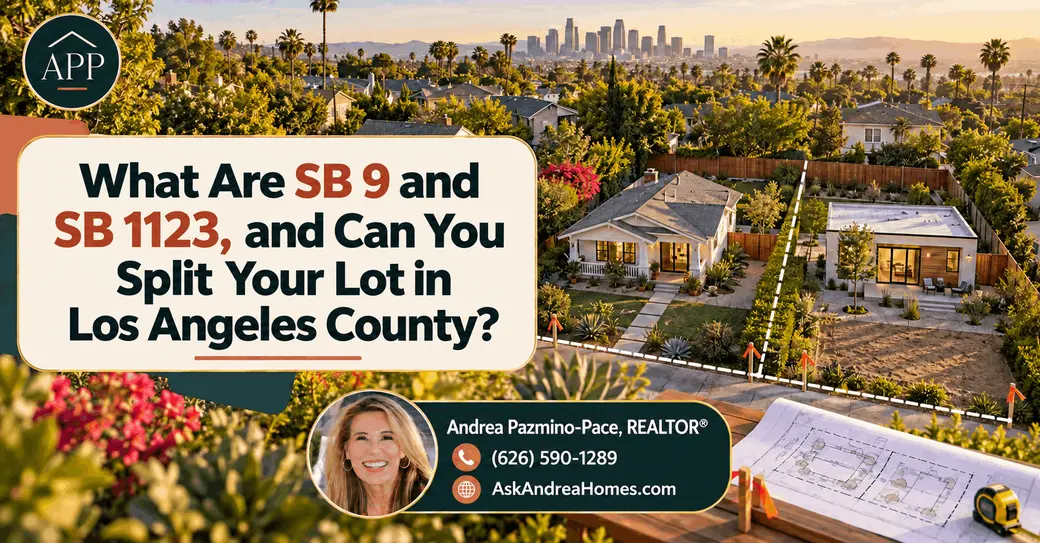
What Are SB 9 and SB 1123, and Can You Split Your Lot in Los Angeles County?
What Does SB 9 Actually Let You Do With Your Lot?
SB 9, also known as the California HOME Act, gives owners of most single-family zoned lots two ministerial options: build a duplex (up to two units) on your existing lot, or split the lot into two separate parcels and build up to two units on each — up to four total homes on what used to be one single-family lot. The lots created by an urban lot split have to be roughly equal, within a 60/40 split, and each new parcel must be at least 1,200 square feet, with the original lot at least 2,400 square feet to qualify. Local agencies can apply objective development standards like setbacks, similar to ADU rules, but they can't impose subjective design requirements just to make a project harder to approve.
Who Qualifies for an SB 9 Lot Split?
The lot has to be zoned single-family residential and sit outside high-risk areas — coastal zones, wetlands, and land with significant wildfire, flood, or earthquake hazard exposure are excluded. One of the biggest catches: the owner has to sign a recorded affidavit promising to occupy one of the units on one of the new parcels as their primary residence for at least three years, which is meant to discourage pure speculation. You also can't use SB 9 to demolish a unit that's been rented out within the past three years, and short-term rentals under 30 days aren't allowed in the new units.
What's Different About SB 1123?
SB 1123, which expanded the 2023 Starter Home Revitalization Act (SB 684), took effect July 1, 2025, and opened ministerial small-lot subdivision to vacant single-family-zoned lots up to 1.5 acres, as long as the site is surrounded by substantially urban development. Unlike SB 9's two-lot cap, SB 1123 allows up to ten units through the ministerial process, with each resulting parcel required to be at least 1,200 square feet. ADUs and junior ADUs don't count against that ten-unit limit if the local agency allows them. There's no owner-occupancy requirement here — SB 1123 is built for builders and developers assembling small-lot "starter home" subdivisions, not for a homeowner looking to split their own backyard.
How Fast Does the Approval Process Move?
Both laws require ministerial review, which means the city or county can't hold public hearings or exercise discretion to deny a qualifying project — they can only check it against objective standards. Under SB 1123, the local agency has 60 days to approve or deny a qualifying application, and if it misses that window, the project is deemed approved. SB 9 doesn't set an identical statutory clock in the same way, but because review is ministerial, most Los Angeles County and city planning departments process complete SB 9 applications in a matter of weeks rather than the months a discretionary subdivision would take.
Does This Apply the Same Way in Every LA County City?
Not exactly. SB 9 and SB 1123 are state laws that override conflicting local zoning, but individual cities and the county's unincorporated areas can still adopt their own objective development standards — setbacks, height limits, lot coverage — as long as those standards don't functionally block projects that would otherwise qualify. Some cities have been slower than others to update their local ordinances to reflect these laws, so it's worth checking with the specific city's planning department (or LA County Planning for unincorporated areas) before assuming your lot automatically qualifies.
Frequently Asked Questions
Can I use SB 9 and SB 1123 on the same lot?
No — they're separate pathways with different eligibility rules. SB 9 works on an existing single-family lot regardless of whether it has a home on it already; SB 1123 only applies to vacant single-family lots up to 1.5 acres.
Do I have to live in one of the new units under SB 9?
Yes, if you're doing an urban lot split. You have to sign a recorded affidavit committing to occupy one of the units on one of the new parcels as your primary residence for at least three years.
Is there a minimum lot size to qualify for SB 9?
Your existing lot generally needs to be at least 2,400 square feet, since each resulting parcel after the split must be at least 1,200 square feet.
Does SB 1123 require me to live in one of the new homes?
No. SB 1123 has no owner-occupancy requirement — it's designed for building and selling small-lot starter homes, not for a homeowner splitting their own property.
Updated for September 2026.
Categories
- All Blogs (158)
- Accessory Dwelling Units (2)
- Accessory Dwelling Units (ADUs) (1)
- ADUs & Home Improvement (78)
- ADUs and Property Improvements (3)
- agregar a alguien en el titulo de la casa (2)
- Albaceas y Administradores (1)
- Apelaciones de Impuestos (1)
- Appeal property taxes in Los Angeles County (1)
- Baldwin Park (2)
- Baldwin Park News (2)
- Baldwin Park property taxes (1)
- Baldwin Park Real Estate (9)
- Baldwin Park Real Estate Market (2)
- Beneficios Fiscales para Propietarios (1)
- Bienes Raíces (4)
- Bienes Raíces de Baldwin Park (1)
- Bienes Raíces de Sucesiones en Los Ángeles (1)
- Bienes Raíces del Condado de Los Ángeles (1)
- Bienes Raíces en Baldwin Park (2)
- Bienes Raíces en Boyle Heights (1)
- Bienes Raíces en California (4)
- Bienes Raíces en East Los Ángeles (3)
- Bienes Raíces en el Condado de Los Ángeles (3)
- Bienes Raíces en el Este de Los Ángeles (1)
- Bienes Raíces en El Monte (1)
- Bienes Raíces en el Sur de California (4)
- Bienes Raíces en Los Ángeles (2)
- bienes y raices en compton (2)
- Bienes y Raices en El Este de Los Angeles (1)
- bienes y raices ideas para vender (2)
- Bienes y Raices in Compton (1)
- bienes y raices in downey ca (1)
- Boyle Heights first-time homebuyer (1)
- Boyle Heights home prices, (1)
- Boyle Heights Mercado Inmobiliario (1)
- Boyle Heights Precios de la Vivienda (1)
- Boyle Heights Primeros Compradores (1)
- Boyle Heights real estate market (1)
- Boyle Heights zoning (2)
- Building Permits (1)
- Buyer Resources (78)
- Buying a Home (3)
- Buying a Home in Baldwin Park (1)
- buying a home in Boyle Heights 2026 (1)
- california bienes y raices (2)
- California Homeowners (3)
- California Homeowners Insurance (1)
- California Probate (1)
- California Property Taxes (1)
- california real estate (2)
- California Real Estate Laws (1)
- California Real Estate Taxes (1)
- Capital Gains Tax (1)
- Challenge assessed home value (1)
- Closing Costs (1)
- Code Enforcement (1)
- comision del agente (1)
- Community Development (1)
- como comprar casa (1)
- como poner una oferta de compra (1)
- Comparative Market Analysis (1)
- Compra de Casas (3)
- Compra de Vivienda (1)
- Compra de Viviendas (2)
- Compradores de Primera Vivienda (1)
- Compradores de Viviendas (1)
- Comprar casa en L.A. (1)
- Compton Real estate (1)
- Comunidades Cercanas al Transporte (1)
- Consejos de Bienes Raíces (1)
- Consejos para Propietarios (1)
- Consejos para Vendedores (1)
- Construcción de ADU (1)
- Construcciones Sin Permisos (1)
- Conversiones de Garaje (2)
- Costo de venta de una casa en LA (3)
- costos al vender su casa (1)
- costos de cierre (1)
- costos de escrow (1)
- costos de venta de casa (1)
- costos de venta de casa en ca (2)
- Cumplimiento de Códigos (1)
- Decline-in-Value Review (1)
- Desarrollo Urbano (1)
- Divulgaciones de la Propiedad (1)
- downey home selling (1)
- Downey market update (1)
- downey real estate (1)
- East Los Angeles (2)
- East Los Angeles Real Estate (6)
- Eastside Los Angeles Real Estate (1)
- Educación Inmobiliaria (8)
- Educación sobre Seguros (1)
- El Monte Real Estate (3)
- El Sereno Bienes Y Raices (1)
- El Sereno Mercado Inmobiliario (1)
- El Sereno Precio de Las Casas (1)
- El Sereno Priemeros-Compradores (1)
- Escrow Fees (1)
- Estate Administration (1)
- Executors and Administrators (1)
- Financing & Mortgages (74)
- first time home buyers (1)
- first-time home buyer (4)
- First-Time Home Buyer Guide (1)
- First-Time Home Buyers (2)
- Foreclosure & Distressed Sales (76)
- Garage Conversions (2)
- Gentrificación y Desarrollo (1)
- Gentrification and Development (1)
- get your offer accepted (1)
- Gravámenes de Contratistas (1)
- Gravámenes sobre Propiedades (1)
- guia para compradores (1)
- Guía para Compradores Primerizos (1)
- Guías de Vecindarios (2)
- Guías del Mercado Local (1)
- Guías para Vender Casa (1)
- Hipoteca y Financiamiento (1)
- Home Buying (1)
- home buying process (2)
- Home Improvement (1)
- home loans (1)
- Home Maintenance (1)
- home offers (1)
- Home Price Trends (1)
- Home Prices & Market Trends (2)
- Home Pricing (1)
- Home Seller Resources (3)
- Home Selling (4)
- home selling cost (1)
- Home Selling Costs (2)
- Home Selling Timeline (1)
- Home Value (2)
- Home Values (2)
- Homeowner Resources (3)
- Homeowner Tips (3)
- Homeowners (2)
- Homeowners Insurance (75)
- Housing Market (1)
- How Much House Can I Afford? (2)
- how to place an offer in a home (1)
- how to purchase a home (1)
- Impuesto sobre Ganancias de Capital (1)
- Impuestos sobre la Propiedad (4)
- Informacion del mercado de casas en Baldwin Park (2)
- Infrastructure Updates (1)
- Inherited Property (2)
- Inversión en Bienes Raíces (1)
- Inversión Inmobiliaria (1)
- Judgment Liens (1)
- LA Real Estate (1)
- LA Real Estate Market (1)
- Local Market Guides (1)
- Long Beach Real Estate (4)
- los angeles bienes y raices (3)
- Los Angeles County assessment appeal (1)
- Los Angeles County Assessor (1)
- Los Angeles County Real Estate (13)
- Los Angeles County Record (1)
- Los Angeles Home Sale Cost (2)
- Los Angeles Home Sellers (1)
- Los Angeles Homeowners (2)
- Los angeles housing (1)
- Los Angeles Housing Market Updates (1)
- Los Angeles Neighborhoods (1)
- Los Angeles Probate Real Estate (1)
- los angeles real estate (2)
- Lower property taxes in California (1)
- Lynwood Real Estate (4)
- Market update (5)
- Market Updates & Trends (74)
- Mechanic’s Liens (1)
- Mejoras del Hogar (1)
- Mejoras para el Hogar (1)
- Mercado de Vivienda (1)
- Mercado Inmobiliario (4)
- Mortgage & Financing (2)
- move up buyers (1)
- Mudanzas y Reubicación (1)
- Multigenerational Living (1)
- Neighborhood Guides (3)
- Neighborhood resource (2)
- Neighborhoods to Watch (1)
- oferta aceptada (1)
- Permisos de Construcción (1)
- Permits & Code Compliance (76)
- Plan de Mejoras (1)
- Planificación Patrimonial (1)
- Precios de Viviendas (1)
- Precios y Tendencias del Mercado (2)
- Preparar una Casa para la Venta (1)
- Preparing Your Home for Sale (1)
- primer comprador en L.A. (1)
- primeros compradores (5)
- Probate & (1)
- Probate & Inherited Property (73)
- Probate Home Sales (1)
- Probate Property Buyers (1)
- Probate Real Estate (1)
- Probate y Bienes Raíces en East Los Angeles (1)
- Programa de Mejoras de Capital (1)
- Property Assessment (1)
- Property Disclosures (1)
- Property Investment (1)
- Property Taxes (77)
- Property Value (1)
- Property-tax appeal deadline (1)
- Property-Tax Appeals (1)
- Property-tax exemptions in California (1)
- Propiedades de Alquiler (1)
- Propiedades de Sucesión (1)
- Propiedades Heredadas (2)
- Propietarios de California (1)
- Propietarios de Vivienda (1)
- Propietarios de Viviendas en California (2)
- Propietarios Mayores de 55 Años (1)
- Proposición 19 (1)
- Proposición 8 (1)
- Proposition 8 (1)
- Proposition 8 property-tax reduction (1)
- Protección de Propiedades (1)
- Real Estate Advice (3)
- Real Estate Education (1)
- real estate en Los Angeles (1)
- Real Estate for Heirs (1)
- Real Estate Investing (1)
- Real Estate Investment & Rentals (74)
- Real Estate Market (1)
- Real Estate Market Trends (1)
- Real Estate Market Updates (2)
- real estate tips (2)
- Realtor Commissions (1)
- Recursos para Compradores (1)
- Recursos para Herederos (1)
- Recursos para Propietarios (4)
- Recursos para Vendedores (1)
- Registros del Condado de Los Ángeles (1)
- remover a alguien del titulo de la casa (1)
- Rental Property (1)
- reparaciones al vender (1)
- Riesgos Naturales (1)
- San Gabriel Valley (1)
- San Gabriel Valley Real Estate (1)
- Seguro contra Terremotos (1)
- Seguro de Vivienda (1)
- Seguros para Propietarios en California (1)
- Seller Resources (81)
- Seller Tips (3)
- Selling a Home (1)
- Selling a Home in Baldwin Park (1)
- Selling a House (1)
- Selling an Inherited Home (1)
- Sentencias Judiciales (1)
- Should You Sell Before Buying? (1)
- Southern California Real Estate (3)
- Step-Up in Basis (1)
- Sucesiones en California (1)
- Tasación de Propiedades (1)
- Tendencias del Mercado Inmobiliario (1)
- tips para duenos de casa (2)
- tips para quienes venden su casa (1)
- Title & Deeds (4)
- Title and Escrow (1)
- Title, Escrow & Closing Costs (74)
- titulo de la casa (1)
- titulo de la propiedad (1)
- Título y Escrow (1)
- Transit-Oriented Communities (1)
- Trust Property (1)
- Unidades de Vivienda Accesoria (ADU) (1)
- Unidades de Vivienda Accesorias (ADU) (1)
- Unpermitted Construction (1)
- Valor de la Propiedad (1)
- Valor de la Vivienda (2)
- Valor de las Propiedades (1)
- Valor de Viviendas (1)
- Vecindarios con Potencial de Crecimiento (1)
- Vecindarios de Los Ángeles (1)
- vender tu casa (1)
- vender una casa (3)
- vendiendo tu casa (3)
- Venta de casa (2)
- Venta de casa en LA (3)
- Venta de Casas (2)
- Venta de Casas Tal Como Están (1)
- Venta de Propiedades Heredadas (2)
- Venta de Viviendas (4)
- Vivienda Multigeneracional (1)
Recent Posts