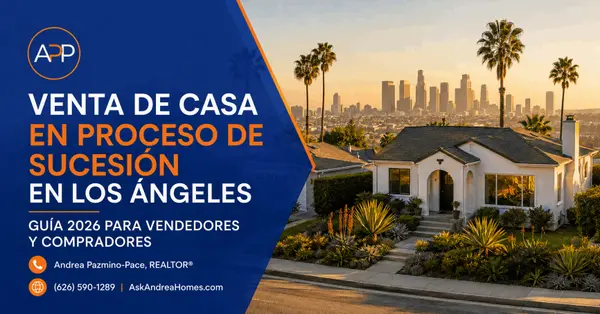
Probate Home Sale in Los Angeles
A 2026 Guide for Executors, Administrators, Heirs, and Home Buyers
By Andrea Pazmino-Pace, REALTOR®
HomeSmart Realty Group | (626) 590-1289 | AskAndreaHomes.com
Updated August 2026
Quick Answer
A probate home sale in Los Angeles occurs when a deceased property owner’s home must be sold through a California probate estate. The court-appointed executor or administrator manages the sale, but the required procedure depends on whether the representative has full authority, limited authority, or no authority under the Independent Administration of Estates Act, commonly called IAEA.
Some probate properties can be sold in a process similar to a traditional home sale. Others require court confirmation, special notices, a probate appraisal, and the opportunity for other buyers to overbid at a hearing.
Before listing or purchasing a Los Angeles probate property, verify the representative’s authority and whether court confirmation is required.
What Is a Probate Home Sale?
Probate is the court-supervised process used to manage and transfer a deceased person’s property.
A home may need to pass through probate when:
-
The deceased owner held the property solely in their name
-
The home was not held in a living trust
-
No beneficiary deed or other valid transfer method applies
-
The named beneficiary died before the owner
-
The estate needs to sell the property to pay debts
-
The heirs want the property sold and the proceeds distributed
-
The ownership records create uncertainty
-
A court order is needed to authorize the transfer
Not every inherited property requires probate. A home held in a living trust, joint tenancy, community property with right of survivorship, or another qualifying ownership arrangement might transfer outside probate.
An attorney should review the deed, estate documents, ownership history, and date of death before anyone assumes that probate is required.
Who Can Sell a Home in Probate?
The person managing the estate is called the personal representative.
The representative may be:
-
An executor named in a will
-
An administrator appointed when there is no will
-
An administrator with the will annexed
-
A special administrator with specific court-authorized powers
Naming someone as executor in a will does not automatically give that person authority to sell the property. The court must appoint the representative and issue Letters Testamentary or Letters of Administration.
The representative’s Letters and court order should be reviewed before the property is listed or an offer is accepted.
What Is IAEA Authority?
The Independent Administration of Estates Act can allow a personal representative to complete certain estate transactions without obtaining court approval for every action.
The representative may receive:
Full authority
Full authority can allow the representative to sell real property without a court-confirmation hearing, provided all legal notice requirements are followed and no qualifying objection prevents the sale.
Limited authority
Limited authority generally requires court confirmation before a real-property sale can be completed.
No IAEA authority
When IAEA authority has not been granted, the representative must follow the court-supervised sale process.
Never assume that a probate listing does or does not require confirmation. Review the actual court documents and sale terms.
Probate Sale With Full IAEA Authority
A sale under full IAEA authority can resemble a conventional transaction, but it remains an estate sale.
A typical process may include:
-
The court appoints the personal representative
-
The court issues Letters
-
The probate referee appraises the property
-
The representative prepares the home for sale
-
The property is listed and marketed
-
The representative accepts an offer subject to probate requirements
-
A Notice of Proposed Action may be sent to interested parties
-
The notice period expires without a valid objection
-
The buyer completes inspections and financing
-
Escrow closes and the proceeds remain with the estate
A Notice of Proposed Action generally provides interested parties with at least 15 days’ notice before the proposed action is taken. The estate’s attorney should determine who must receive notice and whether notice can be waived.
Full authority does not mean that the representative can ignore fiduciary duties. The representative must act in the estate’s best interests and follow the Probate Code, court orders, and terms of the will.
Probate Sale Requiring Court Confirmation
A sale requiring court confirmation follows additional procedures.
The process may include:
-
Appointment of the personal representative
-
Issuance of Letters
-
Appraisal by a probate referee
-
Listing and marketing the property
-
Acceptance of an offer
-
Filing a Report of Sale and Petition for Order Confirming Sale
-
Scheduling a court-confirmation hearing
-
Providing legally required notice
-
Allowing qualified buyers to overbid at the hearing
-
Obtaining the court’s confirmation
-
Completing escrow after the order is entered
The accepted offer is not necessarily the final offer. A qualified buyer may present a higher bid during the confirmation hearing.
This possibility should be clearly explained to the original buyer before the offer is written.
How Does the Probate Overbid Process Work?
When court confirmation is required, the court may invite higher bids at the hearing.
California law establishes the minimum first overbid. It is generally calculated by adding:
-
10% of the first $10,000 of the accepted bid
-
5% of the remaining amount
For example, if the accepted offer is $700,000:
-
10% of the first $10,000 = $1,000
-
5% of the remaining $690,000 = $34,500
-
Minimum first overbid = $735,500
The court controls the bidding procedure and may set later bid increments.
Overbidders should review the property, financing requirements, deposit requirements, sale terms, title information, and court instructions before attending the hearing.
Does a Probate Home Have to Sell Below Market Value?
No.
A probate property is not automatically a discounted property. The personal representative has a fiduciary responsibility to protect the estate and seek an appropriate result.
The price depends on:
-
Property condition
-
Location
-
Comparable sales
-
Occupancy
-
Needed repairs
-
Title issues
-
Marketing exposure
-
Buyer demand
-
Court requirements
-
The representative’s authority
-
Whether confirmation and overbidding are required
A probate home in a desirable Los Angeles neighborhood could attract multiple offers and sell at or above its listing price.
Does the Probate Referee Determine the Sale Price?
A probate referee is appointed to appraise noncash estate assets, including real property.
The probate appraisal is important, especially when court confirmation is required. A court-confirmed private sale generally must satisfy statutory requirements related to the appraised value, subject to applicable exceptions and court findings.
The probate appraisal is not necessarily the same as:
-
A real estate agent’s comparative market analysis
-
A buyer’s lender appraisal
-
A private appraisal ordered by the estate
-
The final sale price
Los Angeles market conditions can change between the probate referee’s valuation date and the listing date. Updated comparable sales should be reviewed before selecting a listing price.
Can the Estate Make Repairs?
The representative may be able to authorize repairs, cleaning, landscaping, debris removal, or other work when those actions benefit the estate and fall within the representative’s authority.
Before spending estate funds, the representative should discuss the work with the probate attorney and maintain records of:
-
Contractor estimates
-
Invoices
-
Receipts
-
Photographs
-
Payments
-
Expected benefit to the estate
Some homes benefit from cleaning, safety corrections, and basic presentation. Major renovations may create unnecessary expense, delays, and disagreements among beneficiaries.
Are Probate Homes Sold As-Is?
Many Los Angeles probate homes are marketed in their current condition, but “as-is” does not eliminate every seller responsibility or buyer right.
The buyer should still investigate:
-
Foundation and structure
-
Roof
-
Plumbing
-
Electrical system
-
HVAC
-
Water intrusion and mold
-
Sewer line
-
Termites
-
Unpermitted additions
-
ADUs and garage conversions
-
Zoning
-
Liens
-
Title issues
-
Occupancy
-
Insurance availability
Certain fiduciary probate sales may be exempt from California’s standard Transfer Disclosure Statement requirements. However, an exemption does not permit fraud or concealment of known material facts.
The estate’s attorney and real estate professional should determine which disclosures and forms apply.
Can an Occupied Probate Property Be Sold?
Yes, but occupancy can affect the sale.
The property may be occupied by:
-
An heir
-
A beneficiary
-
A family member
-
A tenant
-
A caregiver
-
An unauthorized occupant
The representative should obtain legal advice before changing locks, removing belongings, negotiating a move-out, serving notices, or starting an eviction.
California and local tenant protections may apply. Los Angeles properties can also be subject to rent-control and just-cause eviction rules.
How Long Does a Probate Home Sale Take in Los Angeles?
The sale itself could take a few months after the representative receives authority, but the entire probate case may take much longer.
A general timeline may include:
| Stage | Possible time |
|---|---|
| Prepare and file the probate petition | Several weeks |
| Wait for the appointment hearing | Several weeks or longer |
| Receive Letters and obtain the appraisal | Several weeks to months |
| Prepare and market the property | 2–8 weeks |
| Accept an offer | Depends on the market |
| Notice or court-confirmation process | Several weeks to months |
| Escrow after approval | Approximately 30–60 days |
| Complete the entire probate estate | Often 9–18 months or longer |
Contests, title problems, creditor claims, tax issues, occupancy disputes, missing heirs, deferred maintenance, and court scheduling can extend the process.
These are general estimates, not guaranteed deadlines.
Costs Associated With a Probate Sale
Possible expenses include:
-
Court filing fees
-
Probate attorney compensation
-
Personal representative compensation
-
Probate referee fees
-
Real estate commission
-
Escrow and title charges
-
Property taxes
-
Insurance
-
Utilities
-
Maintenance
-
Repairs and cleaning
-
Appraisals
-
Legal notices
-
Debts, liens, or judgments
-
Moving or occupancy-related expenses
California probate attorney and personal-representative statutory compensation is generally calculated using the value of the estate accounted for by the representative, not simply the equity remaining after mortgages.
Extraordinary services may require additional court-approved compensation.
What Sellers Should Do Before Listing
The personal representative should:
-
Confirm that the court has issued valid Letters
-
Determine whether authority is full, limited, or unavailable under IAEA
-
Consult the probate attorney
-
Locate the deed, mortgage, insurance, and tax records
-
Secure the property
-
Identify all occupants
-
Complete the inventory and appraisal process
-
Investigate liens and title problems
-
Document the property’s condition
-
Obtain a local market analysis
-
Decide whether repairs benefit the estate
-
Select a REALTOR® familiar with probate procedures
The representative should not sign a standard listing or purchase agreement without correctly addressing probate authority and required approvals.
What Buyers Should Know
Before making an offer, a buyer should ask:
-
Has the representative been appointed?
-
Have Letters been issued?
-
Does the representative have full or limited IAEA authority?
-
Is court confirmation required?
-
Can another buyer overbid?
-
What deposit is required?
-
Is the sale subject to a Notice of Proposed Action?
-
Is the property occupied?
-
Which disclosures will be provided?
-
Are there known permit or title issues?
-
What contingencies are allowed?
-
When can escrow close?
Probate sales can provide opportunities, but buyers need realistic expectations about timing, property condition, court procedures, and seller authority.
Frequently Asked Questions
Can the heirs sell the home before probate begins?
Generally, heirs cannot sell estate property merely because they expect to inherit it. A court-appointed representative with proper authority must usually execute the sale.
Do all probate sales require court confirmation?
No. A representative with full IAEA authority may be able to sell without confirmation if all requirements are satisfied.
Can an heir object to the sale?
An interested party may be able to object through the required probate procedures. The effect of an objection depends on the representative’s authority, the notice provided, and the court’s decision.
Can a buyer use financing?
Often yes. However, the lender and appraisal timeline must fit the probate terms. Court-confirmed buyers should be prepared for possible overbidding and approval delays.
Can a probate property be sold to a family member?
Possibly, but conflicts of interest, notice, valuation, and court-approval issues may apply. The representative should obtain legal advice.
Does the mortgage disappear when the owner dies?
No. The loan, liens, taxes, and other secured obligations generally remain attached to the property. They are normally addressed through the estate or paid through escrow at closing.
Is probate the same as selling a home from a trust?
No. A successor trustee selling trust property follows the trust document and applicable trust law. That transaction is different from a court probate sale.
Conclusion
A probate home sale in Los Angeles requires more than placing the property on the market. The personal representative must have proper authority, comply with probate notices and court orders, protect the estate, and use the correct real estate documents.
The most important first step is determining whether the representative has full or limited IAEA authority and whether court confirmation is required.
If you are responsible for an inherited property in Los Angeles County, I can help you evaluate its condition, review comparable sales, develop a marketing plan, and coordinate the real estate portion of the sale with your probate attorney.
Andrea Pazmino-Pace, REALTOR®
HomeSmart Realty Group
Phone: (626) 590-1289
Website: AskAndreaHomes.com
Sources: California Courts Probate Guide, Los Angeles Superior Court Probate Division, California Notice of Proposed Action statutes, and California court-confirmation form.
Categories
- All Blogs (89)
- Accessory Dwelling Units (1)
- Accessory Dwelling Units (ADUs) (1)
- ADUs and Property Improvements (1)
- agregar a alguien en el titulo de la casa (2)
- Albaceas y Administradores (1)
- Apelaciones de Impuestos (1)
- Appeal property taxes in Los Angeles County (1)
- Baldwin Park (2)
- Baldwin Park News (2)
- Baldwin Park property taxes (1)
- Baldwin Park Real Estate (9)
- Baldwin Park Real Estate Market (2)
- Beneficios Fiscales para Propietarios (1)
- Bienes Raíces (4)
- Bienes Raíces de Baldwin Park (1)
- Bienes Raíces de Sucesiones en Los Ángeles (1)
- Bienes Raíces del Condado de Los Ángeles (1)
- Bienes Raíces en Baldwin Park (2)
- Bienes Raíces en Boyle Heights (1)
- Bienes Raíces en California (3)
- Bienes Raíces en East Los Ángeles (2)
- Bienes Raíces en el Condado de Los Ángeles (3)
- Bienes Raíces en el Este de Los Ángeles (1)
- Bienes Raíces en El Monte (1)
- Bienes Raíces en el Sur de California (4)
- Bienes Raíces en Los Ángeles (1)
- bienes y raices en compton (2)
- Bienes y Raices en El Este de Los Angeles (1)
- bienes y raices ideas para vender (2)
- Bienes y Raices in Compton (1)
- bienes y raices in downey ca (1)
- Boyle Heights first-time homebuyer (1)
- Boyle Heights home prices, (1)
- Boyle Heights Mercado Inmobiliario (1)
- Boyle Heights Precios de la Vivienda (1)
- Boyle Heights Primeros Compradores (1)
- Boyle Heights real estate market (1)
- Boyle Heights zoning (2)
- Building Permits (1)
- Buyer Resources (4)
- Buying a Home (3)
- Buying a Home in Baldwin Park (1)
- buying a home in Boyle Heights 2026 (1)
- california bienes y raices (2)
- California Homeowners (2)
- California Probate (1)
- California Property Taxes (1)
- california real estate (2)
- California Real Estate Laws (1)
- California Real Estate Taxes (1)
- Capital Gains Tax (1)
- Challenge assessed home value (1)
- Closing Costs (1)
- Code Enforcement (1)
- comision del agente (1)
- Community Development (1)
- como comprar casa (1)
- como poner una oferta de compra (1)
- Comparative Market Analysis (1)
- Compra de Casas (3)
- Compra de Vivienda (1)
- Compra de Viviendas (1)
- Compradores de Primera Vivienda (1)
- Compradores de Viviendas (1)
- Comprar casa en L.A. (1)
- Compton Real estate (1)
- Comunidades Cercanas al Transporte (1)
- Consejos de Bienes Raíces (1)
- Consejos para Propietarios (1)
- Consejos para Vendedores (1)
- Construcción de ADU (1)
- Construcciones Sin Permisos (1)
- Conversiones de Garaje (2)
- Costo de venta de una casa en LA (2)
- costos al vender su casa (1)
- costos de cierre (1)
- costos de escrow (1)
- costos de venta de casa (1)
- costos de venta de casa en ca (2)
- Cumplimiento de Códigos (1)
- Decline-in-Value Review (1)
- Desarrollo Urbano (1)
- Divulgaciones de la Propiedad (1)
- downey home selling (1)
- Downey market update (1)
- downey real estate (1)
- East Los Angeles (1)
- East Los Angeles Real Estate (6)
- Eastside Los Angeles Real Estate (1)
- Educación Inmobiliaria (5)
- El Monte Real Estate (3)
- El Sereno Bienes Y Raices (1)
- El Sereno Mercado Inmobiliario (1)
- El Sereno Precio de Las Casas (1)
- El Sereno Priemeros-Compradores (1)
- Escrow Fees (1)
- Estate Administration (1)
- Executors and Administrators (1)
- first time home buyers (1)
- first-time home buyer (4)
- First-Time Home Buyer Guide (1)
- First-Time Home Buyers (2)
- Garage Conversions (2)
- Gentrificación y Desarrollo (1)
- Gentrification and Development (1)
- get your offer accepted (1)
- Gravámenes de Contratistas (1)
- Gravámenes sobre Propiedades (1)
- guia para compradores (1)
- Guía para Compradores Primerizos (1)
- Guías de Vecindarios (2)
- Guías del Mercado Local (1)
- Guías para Vender Casa (1)
- Hipoteca y Financiamiento (1)
- Home Buying (1)
- home buying process (2)
- Home Improvement (1)
- home loans (1)
- Home Maintenance (1)
- home offers (1)
- Home Price Trends (1)
- Home Prices & Market Trends (2)
- Home Pricing (1)
- Home Seller Resources (3)
- Home Selling (4)
- home selling cost (1)
- Home Selling Costs (2)
- Home Selling Timeline (1)
- Home Value (2)
- Home Values (2)
- Homeowner Exemptions (1)
- Homeowner Resources (4)
- Homeowner Tips (3)
- Homeowners (2)
- Homeowners Insurance (1)
- Housing Market (1)
- How Much House Can I Afford? (2)
- how to place an offer in a home (1)
- how to purchase a home (1)
- Impuesto sobre Ganancias de Capital (1)
- Impuestos sobre la Propiedad (3)
- Informacion del mercado de casas en Baldwin Park (2)
- Infrastructure Updates (1)
- Inherited Property (2)
- Inversión en Bienes Raíces (1)
- Inversión Inmobiliaria (1)
- Judgment Liens (1)
- LA Real Estate (1)
- LA Real Estate Market (1)
- Local Market Guides (1)
- los angeles bienes y raices (3)
- Los Angeles County assessment appeal (1)
- Los Angeles County Assessor (1)
- Los Angeles County Property Taxes (1)
- Los Angeles County Real Estate (4)
- Los Angeles County Record (1)
- Los Angeles Home Sale Cost (2)
- Los Angeles Home Sellers (1)
- Los Angeles Homeowners (1)
- Los angeles housing (1)
- Los Angeles Housing Market Updates (1)
- Los Angeles Neighborhoods (1)
- Los Angeles Probate Real Estate (1)
- los angeles real estate (2)
- Lower property taxes in California (1)
- Market update (5)
- Mechanic’s Liens (1)
- Mejoras del Hogar (1)
- Mejoras para el Hogar (1)
- Mercado de Vivienda (1)
- Mercado Inmobiliario (4)
- Mortgage & Financing (2)
- move up buyers (1)
- Mudanzas y Reubicación (1)
- Multigenerational Living (1)
- Neighborhood Guides (2)
- Neighborhood resource (1)
- Neighborhoods to Watch (1)
- oferta aceptada (1)
- Permisos de Construcción (1)
- Plan de Mejoras (1)
- Planificación Patrimonial (1)
- Precios de Viviendas (1)
- Precios y Tendencias del Mercado (2)
- Preparar una Casa para la Venta (1)
- Preparing Your Home for Sale (1)
- primer comprador en L.A. (1)
- primeros compradores (5)
- Probate Home Sales (1)
- Probate Property Buyers (1)
- Probate Real Estate (1)
- Probate y Bienes Raíces en East Los Angeles (1)
- Programa de Mejoras de Capital (1)
- Property Assessment (1)
- Property Disclosures (1)
- Property Investment (1)
- Property Taxes (2)
- Property Value (1)
- Property-tax appeal deadline (1)
- Property-Tax Appeals (2)
- Property-tax exemptions in California (1)
- Propiedades de Alquiler (1)
- Propiedades de Sucesión (1)
- Propiedades Heredadas (2)
- Propietarios de California (1)
- Propietarios de Vivienda (1)
- Propietarios de Viviendas en California (2)
- Propietarios Mayores de 55 Años (1)
- Proposición 19 (1)
- Proposición 8 (1)
- Proposition 13 (1)
- Proposition 19 (1)
- Proposition 8 (2)
- Proposition 8 property-tax reduction (1)
- Real Estate Advice (2)
- Real Estate Education (1)
- Real Estate for Heirs (1)
- Real Estate Investing (1)
- Real Estate Market (1)
- Real Estate Market Trends (1)
- Real Estate Market Updates (2)
- real estate tips (1)
- Realtor Commissions (1)
- Recursos para Compradores (1)
- Recursos para Herederos (1)
- Recursos para Propietarios (3)
- Recursos para Vendedores (1)
- Registros del Condado de Los Ángeles (1)
- remover a alguien del titulo de la casa (1)
- Rental Property (1)
- reparaciones al vender (1)
- San Gabriel Valley (1)
- San Gabriel Valley Real Estate (1)
- Seguro de Vivienda (1)
- Seller Resources (5)
- Seller Tips (3)
- Selling a Home (1)
- Selling a Home in Baldwin Park (1)
- Selling a House (1)
- Selling an Inherited Home (1)
- Sentencias Judiciales (1)
- Should You Sell Before Buying? (1)
- Southern California Real Estate (3)
- Step-Up in Basis (1)
- Sucesiones en California (1)
- Tasación de Propiedades (1)
- Tendencias del Mercado Inmobiliario (1)
- tips para duenos de casa (2)
- tips para quienes venden su casa (1)
- Title & Deeds (4)
- Title and Escrow (1)
- titulo de la casa (1)
- titulo de la propiedad (1)
- Título y Escrow (1)
- Transit-Oriented Communities (1)
- Trust Property (1)
- Unidades de Vivienda Accesoria (ADU) (1)
- Unidades de Vivienda Accesorias (ADU) (1)
- Unpermitted Construction (1)
- Valor de la Propiedad (1)
- Valor de la Vivienda (2)
- Valor de las Propiedades (1)
- Valor de Viviendas (1)
- Vecindarios con Potencial de Crecimiento (1)
- Vecindarios de Los Ángeles (1)
- vender tu casa (1)
- vender una casa (3)
- vendiendo tu casa (3)
- Venta de casa (2)
- Venta de casa en LA (3)
- Venta de Casas (2)
- Venta de Casas Tal Como Están (1)
- Venta de Propiedades Heredadas (2)
- Venta de Viviendas (3)
- Vivienda Multigeneracional (1)
Recent Posts